I-Five
The Last JediI-Five is a sentient protocol droid, but neither his identity nor his role in the story is confined to a single machine body. His memories persist through the loss and replacement of chassis; his technical ingenuity repeatedly changes what he can do; and his loyalty to Jax Pavan culminates in a rescue that recalls Jax’s father, Lorn Pavan. The contrast between his mechanical construction and his apparent connection to the Force makes him not just the group’s capable operator, but a challenge to its assumptions about what kinds of beings can possess inner life.
Identity and Memory
I-Five’s history gives memory a particular weight. The memories of Lorn Pavan’s death, along with the memory of Tuden Sal’s betrayal of him, had once been wiped. About twenty years later they were restored in vivid, complete detail. Their return shows that erasure did not necessarily mean permanent loss, but it also brought back painful knowledge rather than a clean slate. Den Dhur wonders how I-Five can continue working with Tuden Sal in Whiplash after that betrayal. The question highlights a difference between them: Den imagines he could not be so sanguine, while I-Five can maintain working relationships without pretending that the past never happened.
I-Five describes organic memory as subject to the emotional currents attached to remembered events: memories can change, expand, contract, acquire epic proportions, or become submerged. He calls this process both a strength and a weakness. His own restored memories, by contrast, are presented as mercilessly intact. The distinction does not make him emotionless; it makes the way he carries the past different from Den’s, and gives his later words to Jax about Lorn the force of an old loss still held in precise detail.
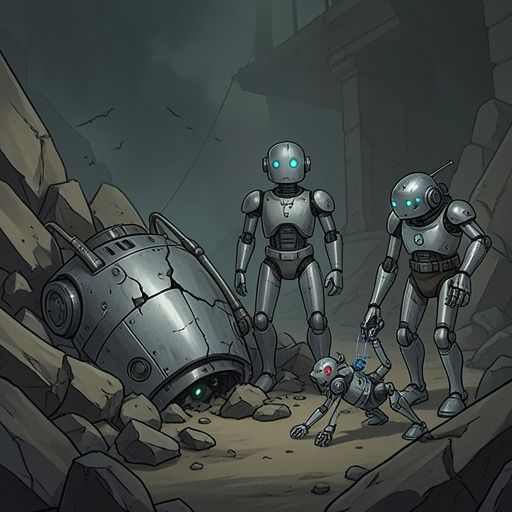
That continuity belongs to the droid rather than to any one chassis. After an attack leaves his head battered and blackened on the deck, the story does not treat a damaged body as the end of I-Five. His neural processor can be moved, and a later effort to rebuild him proceeds through a succession of improvised mechanical forms. The repeated separation of mind from body turns a practical engineering problem into a question of identity: I-Five remains himself while the hardware that expresses his capabilities changes around him.
Rebuilding and Expanding His Capabilities
The prospect of a new body quickly becomes a design question. After Geri explains that a rudimentary chassis has no brain and only basic reflexes, I-Five considers whether his cortex will fit beneath its helm. He weighs its strength, maneuverability, modifiability, and manual dexterity, especially the possibility of modifying the body himself. Geri notes that the chassis would need alterations and suggests mounting I-Five’s head directly onto it; Den Dhur cannot suppress a chuckle at the image. Their exchange establishes the practical, lightly comic character of I-Five’s continuing reconstruction, while showing that he participates in decisions about his own form rather than simply receiving a body chosen for him.
I-Five is particularly interested in the portability of the neural processor that Geri’s resistance mech-tech has made possible. He imagines wearing droid bodies as people wear clothing. In the Laranth’s cargo hold, Den and I-Five work on separate I-5YQ components, but the available parts are incomplete: the vendor has no whole unit, and the pieces they acquire came from several droids reportedly caught in a bad day involving the Desilijic clan on Nal Hutta. I-Five’s interest in changing bodies therefore develops amid scarcity and salvage, not a convenient supply of finished machines.
He also repurposes components from a Trang Robotics N-101 Nemesis droid. Its forearms provide a laser cannon and repulsor-ray generator, a marked increase over the single laser once incorporated into each index finger of I-Five’s original chassis. The other fingers had since been revised to include additional defensive mechanisms. I-Five admires the Nemesis design’s ability to collapse into a compact unit and its protective, camouflage-like posture, but he recognizes that his acquired weapons trade stealth for raw power. He proposes a secondary cortex in each chassis so that he can transfer himself as needed, a plan that makes Den wonder whether such versatility would render him redundant. The humor rests on a real shift: I-Five’s mobility and self-modification are changing the group’s idea of what his body can be used for.
Technical Work and the Search for Yimmon
I-Five’s flexibility also makes him a central intelligence-gathering resource. While Jax Pavan is away, he interfaces with accessible city subsystems and finds an unusual flow of credits from Imperial coffers into concealed accounts on Mandalore. He and Jax agree with Den’s suspicion that the payments may concern bounty hunters, though their purpose remains uncertain. The possibility that the Empire is hiring hunters to pursue Jedi carries two implications at once: Darth Vader may be stalking Jedi, but his actions also suggest that he believes Jedi still survive.
When Jax sets out alone to find Thi Xon Yimmon, I-Five offers a plausible explanation: a single Jedi might have a better chance at a rescue than one burdened by two miniature companions. Den rejects the idea that I-Five is a liability, pointing to the laser units they have installed. But when Jax considers using Black Sun resources, I-Five is wary. He and Den leave to complete the retrofit rather than follow Jax into a partnership with Prince Xizor, questioning what they can accomplish if Jax is determined to pursue that route. Their separation does not become abandonment. Once Jax’s flirtation with Black Sun provides a possible opening at Kantaros Station, I-Five’s skills help turn that knowledge into a plan to enter under Black Sun cover.
The plan depends on an earlier act of preparation. While on the landing pad at Keldabe with Prince Xizor’s fleet, I-Five had sliced several identification codes. He can now tell Den that the station’s command-and-control system will identify their ship as the Raptor out of Mandalore. His technical competence is not merely an accessory to Jax’s plans: it creates an operational route into a heavily guarded place when the group lacks legitimate credentials.
Infiltration and Rescue
I-Five’s improvisations continue inside the Red Zone. After Sacha Swiftbird recognizes a possible way in, I-Five determines how to exploit it. Less than ten minutes later, polished and posing as R2-Five, he rolls from the shadow of a Mimban freighter and passes through the Red Zone portal alongside the other droids, disappearing beyond the guards. The disguise converts an apparent vulnerability—a conspicuous machine approaching a guarded entrance—into cover. Later, when Sacha needs additional surveillance, the prospect of using more than one version of I-Five reflects how valuable, and how stretched, his presence has become.
When I-Five discovers that the Empire is moving Yimmon, he locates the destination: the medbay, two levels above the high-security area and nearly as well protected. He inserts a data wand into an AI port and learns that an operating room has been prepared for neurosurgery. The medbay AI cannot identify the procedure because Darth Vader has sealed access to that information. The finding sharpens the urgency without resolving the mystery of what the Empire intends to do to Yimmon.
During the ensuing infiltration, I-Five, still in his R2 persona, opens the medbay doors and then disappears from the immediate scene. Jax Pavan and Sacha Swiftbird bring Probus Tesla’s body inside and leave it out of sight of the entrance. Jax orders Den to lock the doors while he and Sacha search for I-Five; they find him speaking to the computer controlling Yimmon’s autonomic processes. I-Five’s access to the system places him at the boundary between machine control and a human prisoner reduced, in Jax’s perception, to a sleeping body. His ability to communicate with the computer is instrumental to the rescue, while the information he has uncovered makes the threat of the planned operation concrete.
Loyalty, the Force, and Narrative Significance
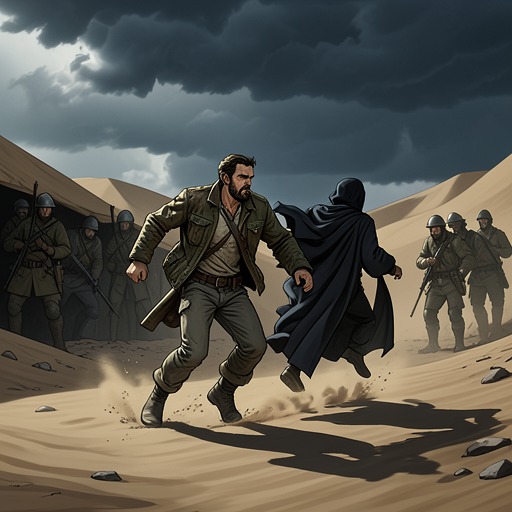
I-Five’s loyalty becomes most visible when Jax is running from danger. Jax initially sees a stranger at the center of the light, then recognizes a human replicant droid carrying the Nemesis blaster rifle on his android arm. I-Five’s face shows grim determination as he tells Jax, “I am not losing you the way I lost your father.” The line joins two relationships across time: the loss of Lorn Pavan, preserved in I-Five’s restored memory, and his determination not to lose Lorn’s son in the same way. Jax keeps moving while blasterfire intensifies behind him and an explosion throws him against a courier vessel’s landing strut. I-Five’s intervention is not simply tactical support; it turns memory into a reason to put himself between an old grief and its possible repetition.
Afterward, Jax withdraws into the woods and eventually returns to meditation, recognizing that he had cut himself off from the Force. When he opens his eyes, he senses a man in the room and recognizes I-Five not by appearance but by the unmistakable aura of the Force. Jax thinks of him as his closest friend, one who had kept faith that he would return when nearly everyone else had given up. Their reunion follows Jax’s renewed connection to the Force and gives I-Five’s steadfastness a place in the story’s emotional recovery, without making him merely a device for Jax’s grief.
The encounter also opens a question the book does not immediately answer. Jax observes that accepted doctrine connects the Force’s manifestation through living things to midi-chlorians and that I-Five’s neuroprocessor has no organic components. His original I-5YQ chassis and interim bodies were likewise nonorganic; even the human replicant body is synthflesh and nanomolecular electronics. I-Five agrees that he has no midi-chlorians. Yet Jax insists that the Force lives within him and asks how to account for it. The scene places I-Five’s constructed, changeable existence against a theory that seems to reserve the Force for organic life. Rather than supplying a technical explanation, it leaves his presence as a challenge to the boundary between machine and living being—and makes the droid who has repeatedly changed bodies one of the story’s clearest tests of what personhood can include.